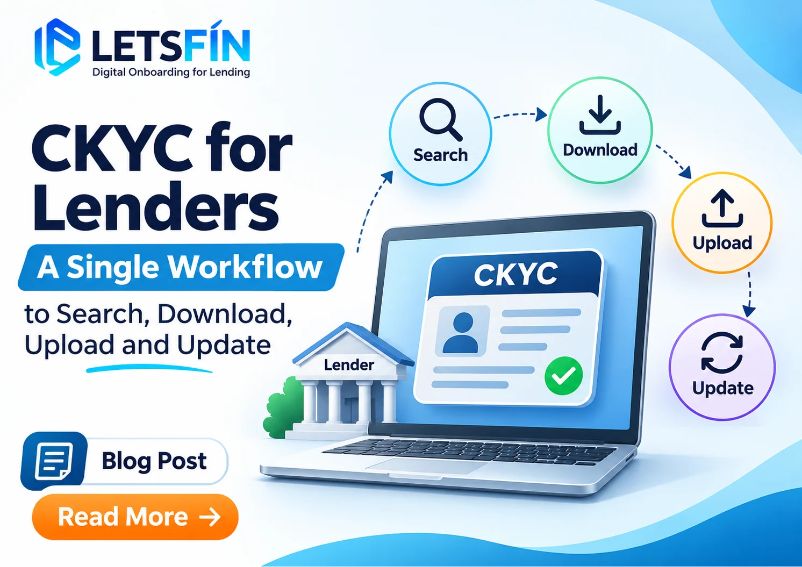
How CKYC Works for Lenders: Search, Download, Upload and Update in One Workflow
November 25, 2026
How CKYC works, in short: a lender first searches India's Central KYC Records Registry (CKYCR) for the customer's KYC Identifier (KIN). If a record exists, the lender downloads it instead of collecting documents again. If none exists, the lender completes its own KYC and uploads the record. Whenever customer details change, the lender updates the registry, and the registry in turn tells other lenders about changes made elsewhere.
For NBFCs and banks, the hard part is the sequence and the clocks attached to each step. This guide covers both.
General information for fintech and lending teams, not legal or compliance advice. Confirm obligations against the current RBI Directions for your entity type.
How CKYC works: the registry, the KIN and the four operations
CKYCR is the central repository of customer KYC records. CERSAI operates it, and regulated entities such as banks and NBFCs read from it and write to it. Once a customer's KYC is registered, they get a unique 14-digit KYC Identification Number (KIN) that institutions can use to pull the verified record.
RBI's KYC rules expect lenders to use that record. To onboard a customer, update their KYC or verify identity, an RE must ask the customer for the KIN or retrieve it from CKYCR, then fetch the records online. It should not ask for the same documents again, except in four situations covered below.
Four operations make up the workflow:
| Operation | When it is triggered | Input | Output | Who initiates |
| Search | Start of onboarding, and before any upload | Customer identifiers (PAN, mobile number, partial Aadhaar, other ID numbers) | A KIN if a record exists, otherwise no match | Lender |
| Download | After a search returns a KIN | KIN plus an authentication factor | The customer's KYC record | Lender |
| Upload | No record found after a thorough search | Verified KYC data and documents in CERSAI's format | A new KIN for the customer | Lender |
| Update | The customer provides changed details, or CKYCR reports a change made elsewhere | Updated KYC data (outbound), or the KIN (inbound retrieval) | The registry record is revised; other linked lenders are notified | Lender (outbound); CKYCR notifies, lender retrieves (inbound) |
Per the PwC overview of CKYC, download works with a CKYC identifier plus an authentication factor, and API access involves IP whitelisting on both the institution's and CERSAI's side. Check the current CERSAI specification for exact fields.
CKYC search: find the KIN before you collect anything
Search is the gate for the whole workflow. Its job is to find out whether this customer already has a KIN.
Single-field searches miss records. In an April 2026 notification on legacy data, CKYCRR asked reporting entities to use multi-parameter search (PAN, mobile number, partial Aadhaar, passport, voter ID and similar) through API or bulk search. It also said fresh upload should follow only when no match is found after an exhaustive search. Duplicate KINs are the cost of skipping that step.
Our analysis: build search as a retry ladder. Try the strongest identifier first, then fall back through the others before declaring "no record", and log every attempt for an audit.
CKYC download: pull the record, then decide what's still missing
A search hit gives you a KIN. Download retrieves the underlying record. A match isn't the end of due diligence, though. RBI allows a lender to ask for documents again only if:
1. the customer's information has changed from what CKYCR holds;
2. the retrieved record is incomplete or doesn't meet current KYC norms;
3. the validity of the downloaded documents has lapsed; or
4. the lender needs more to verify identity or address, run enhanced due diligence or build the risk profile.
The RBI circular of 6 November 2024 sets out these conditions. In practice, your download step needs a validation layer that checks completeness, document validity and a risk review before you accept the record.
CKYC upload for NBFCs: when no record exists
If search finds nothing, the lender runs its own customer identification (for example Aadhaar-based eKYC, video KYC or other permitted methods) and then uploads the verified record. CKYCR issues a KIN, which reaches the customer by SMS or email.
The timeline is the part teams miss. Summaries of the PML Rules and RBI's amendments, such as Vinod Kothari's note for NBFCs, say new records must be uploaded within 10 days of commencement of the account-based relationship. The Fintales analysis describes the same 10-day window as consistent across regulated entities.
Some third-party guides state different windows, such as 3 working days or 10 working days. Verify against the rules for your entity type before encoding the deadline.
CKYC record update: two directions
Update runs both ways:
- Outbound. When the lender receives updated information from a customer, RBI's amendment requires it to furnish the update to CKYCR within seven days, or within any period the Central Government notifies.
- Inbound. CKYCR then informs the other reporting entities that have dealt with that customer. Once notified, a lender must retrieve the updated record and refresh its own copy.
Many teams build the outbound path and forget the inbound one. The result is an internal record that drifts from the registry.
An end-to-end CKYC onboarding sequence for lenders
The sequence below is an illustrative workflow for a personal-loan application. It is not a client case study.
1. Capture consent and identifiers in the application (PAN, mobile number, and the KIN if the customer knows it).
2. Run CKYC Search with the retry ladder described above.
3. Branch on the result. A match goes to step 4. No match after exhaustive search goes to step 6.
4. Run CKYC Download with the KIN and authentication factor.
5. Validate the record against the four conditions. Request fresh documents only if one applies.
6. Complete your own KYC if there was no match, using your permitted onboarding methods.
7. Run your own risk steps: screening, risk categorisation and any enhanced due diligence. A CKYC record supports your risk assessment but doesn't replace it.
8. Store the KIN against the customer's UCIC. RBI's amendment says CDD is applied at UCIC level, so an existing KYC-compliant customer taking another product from the same lender needs no fresh identification.
9. Start the clocks. Schedule the upload (if applicable) inside the 10-day window, with a safety buffer. Set up handling for the seven-day outbound update and for inbound update notifications.
What to confirm before you build
- Your regulatory text. RBI replaced the 2016 KYC Master Direction on 28 November 2025 with separate directions for each type of regulated entity, including one for NBFCs. Check the CKYCR paragraphs in the version that applies to you.
- CERSAI access. CKYC operations require CERSAI registration and, for API access, IP whitelisting, as noted on LetsFin's CKYC listing.
- Registry version. CERSAI is moving from CKYCRR 1.0 to 2.0. A 12 October 2026 CERSAI notification, as reported by ZIGRAM, puts 2.0 availability tentatively in the first week of November 2026. That report also covers registration cut-offs for reporting entities. For what 2.0 changes in practice, see LetsFin's CKYC 2.0 explainer. Confirm your own go-live date with CERSAI.
- Provider coverage. Most lenders reach CKYCR through a specialist provider. To see which providers cover Search, Download, Upload and Update, compare the CKYC Verification APIs listed on LetsFin.
FAQs
1. What is CKYC?
CKYC is India’s central registry of customer KYC records. A customer’s KYC is verified and stored once, then reused by banks, NBFCs and other regulated lenders, so they don’t have to collect the same documents again.
2. What is a KIN?
KIN stands for KYC Identification Number. It is a unique 14-digit number issued when a customer’s KYC record is first registered. Lenders use it to find and retrieve that customer’s record.
3. What are the four CKYC operations?
Search finds out whether a customer already has a record. Download retrieves that record. Upload adds a new record when none exists. Update changes an existing record when the customer’s details change.
4. How quickly must a lender upload or update a CKYC record?
A new record should be uploaded within 10 days of the account-based relationship starting. When a customer gives updated information, the lender should send it to the registry within 7 days. Check the rules for your entity type before building these deadlines into your system.
5. Does a CKYC record replace a lender’s own checks?
No. A CKYC record saves repeat document collection, but the lender still runs its own risk checks. It can also ask for fresh documents if the record is incomplete, outdated or has changed.